
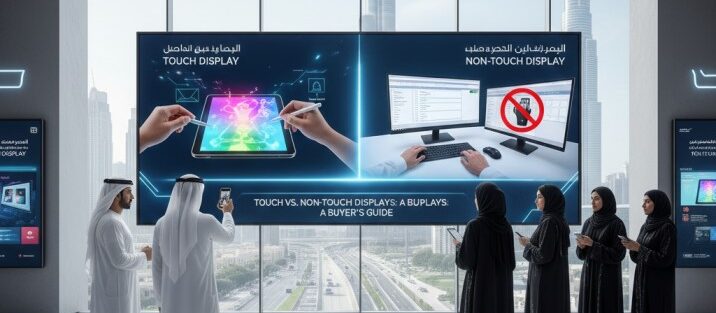
How to Choose Between Touch & Non-Touch Displays: A Buyer’s Guide
Choosing the right display for your business has become more important than ever. Whether you’re in retail, education, hospitality, corporate, healthcare, or public services, the display you select directly influences how people interact with your brand. Today, businesses have two primary options: touch displays and non-touch displays. Both are powerful in their own ways — but the ideal choice depends entirely on your environment, goals, and user behaviour. In this detailed guide from Hynits, we help you understand which display type suits your needs so you can make your next investment confidently.
Touchscreen technology has transformed how people interact with information. From smartphones to kiosks to smart classrooms, touch displays make communication more personal, intuitive, and fast. They turn a simple screen into an interactive experience where users can zoom, swipe, tap, write, or annotate. This makes touch displays perfect for education, training rooms, corporate collaboration, malls, self-service kiosks, and customer-facing environments. If you want engagement, interaction, and real-time participation, touch panels offer unmatched advantages.
On the other hand, non-touch displays are built for simple, clear, high-quality content delivery without the involvement of users. They are ideal for advertising, information display, digital signboards, menu boards, video walls, transport hubs, and large-scale commercial spaces where audience interaction is unnecessary. These displays are durable, cost-effective, and highly impactful for brands that want to broadcast messages, visuals, videos, promotions, or announcements. When long hours of continuous playback and wide visibility are required, non-touch models offer the perfect solution.
So how do you choose between these two? It starts with understanding your purpose. If your business requires user involvement, like in a classroom where students collaborate, a showroom where customers explore product options, or a hospital where visitors use self-check-in kiosks, a touch display is the clear winner. These screens enhance engagement, reduce manual workload, improve efficiency, and make your environment feel modern and intuitive. They also support features like handwriting recognition, multi-touch collaboration, gesture control, and interactive apps — making them a future-ready investment.
However, if your goal is to display high-impact visuals without user interaction, a non-touch display is more suitable. Retail stores, banks, restaurants, hotels, airports, metros, gyms, and theatres often use non-touch signage to catch attention, communicate offers, guide people, and promote brand identity. Because these screens run continuously, they are engineered for durability, brightness, and long life. They’re also available in multiple sizes, orientations, and brightness levels, making them flexible for both indoor and outdoor communication.
Next, consider your footfall and audience behaviour. If the people using your space expect interaction — like students, customers, or staff — touch screens enhance productivity and satisfaction. If most viewers are simply passersby consuming information visually, non-touch signage gets the job done more efficiently. Budget also plays a role. Touch displays often cost more due to advanced sensors and interactive hardware, whereas non-touch screens are more economical for high-volume installations. It’s important to balance your budget with your long-term goals, usage frequency, and expected ROI.
Another factor is location. Touch displays perform best in indoor or controlled environments where they can be used comfortably. Non-touch screens, especially high brightness or outdoor variants, are built to withstand sunlight, dust, and long operational hours — making them better for external communication or heavy-duty settings like transportation hubs or quick-service restaurants.
At Hynits, we design both touch and non-touch displays for real-world performance. Our interactive panels enhance collaboration in schools and boardrooms. Our digital signage solutions help brands communicate smarter and faster. And our commercial displays, kiosks, video walls, and LED solutions offer businesses the flexibility to innovate and transform any space. Every Hynits product is engineered with the latest technology, long-lasting components, and eco-friendly principles that support sustainability and operational efficiency.
Conclusion
In conclusion, the right choice depends on your business needs, user expectations, content strategy, and long-term plan. Touch displays are perfect for engagement and interaction, while non-touch displays excel in delivering visual impact at scale. If you’re unsure which one suits your environment, our experts at Hynits can guide you with personalized recommendations.